
Involuntary or Forced Retirement is when the decision to retire was not yours. Involuntary Retirement can occur when one or all of these conditions apply:
- You are no longer able to work due to physical or mental health issues and are forced to retire sooner than planned.
- You have been laid off due to poor economic conditions or restructuring and have been unable to find work since because:
- there is no work available,
- of your age (ageism)
- You chose early retirement, even though not really ready, due to poor working conditions, ageism, or an early retirement package.
In each of the above, the decision to retire was not really yours.
ExamplesMarwa was laid off 2 years agoMarwa is a 58-year-old woman who worked for the same company for most of her adult life and has always had great work reviews. A little over two years ago she was laid off due to company restructuring and has not been able to find work since even though qualified and experienced. After sending out dozens of resumes with little or no response, and with her savings nearly depleted she decided to take early retirement drawing on her Canada pension and previous work pension plans. This has had a significant impact on her self esteem and confidence not to mention financial resources, and she has become quite anxious about her future. Peter planned on part-time work after retirementPeter is a 67-year-old retiree. He voluntarily retired at 65 from a successful career as a senior software engineer and had planned to continue to work part-time as a way of sharing his knowledge, staying engaged, and earning additional income to supplement his pension. Unfortunately, Peter has not been able to find any work after retirement and has been to only two interviews with no subsequent job offers. Peters’ sense of self and belonging was very much tied to his career and he is experiencing a significant sense of loss and self-doubt. Samantha feels she was a victim of ageismSamantha is a 62 year old woman who was laid off from her work a little over 2 years ago. She had not been able to find work even though qualified and experienced. She slowly began to feel that her age got in the way of her being called in for interviews, let alone getting hired. She recently opted to take an early retirement drawing on her Canada pension and work pension plans rather than continue to deplete her savings. This has had a significant impact on her self esteem and confidence not to mention financial resources, and she has become quite depressed. |
What is the Impact of Involuntary Retirement?
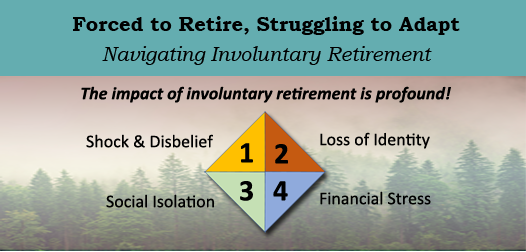
Involuntary Retirement often leads to:
- Social Isolation,
- Financial stress,
- Loss of identity,
- Grieving for previous career,
- Shock and disbelief.
These can lead to anxiety, depression, prolonged grieving, and difficulty transitioning to this new stage in life.
What can you do?
You’ve heard this before … work-life balance. Research has shown that the more a person identifies with their job, the greater the shock, grief, and identity-loss should they find themselves forced to retire.
- Give yourself permission to grieve for what you have lost.
- Be open about how you are feeling especially with those closest to you.
- Consider alternative employment options/careers.
- Keep hope alive!
- Talk to a counsellor.
Resources
Ageism Takes Toll on Physical, Mental Health (2022)
If you are experiencing Involuntary Retirement and would like to talk, please book an appointment today.